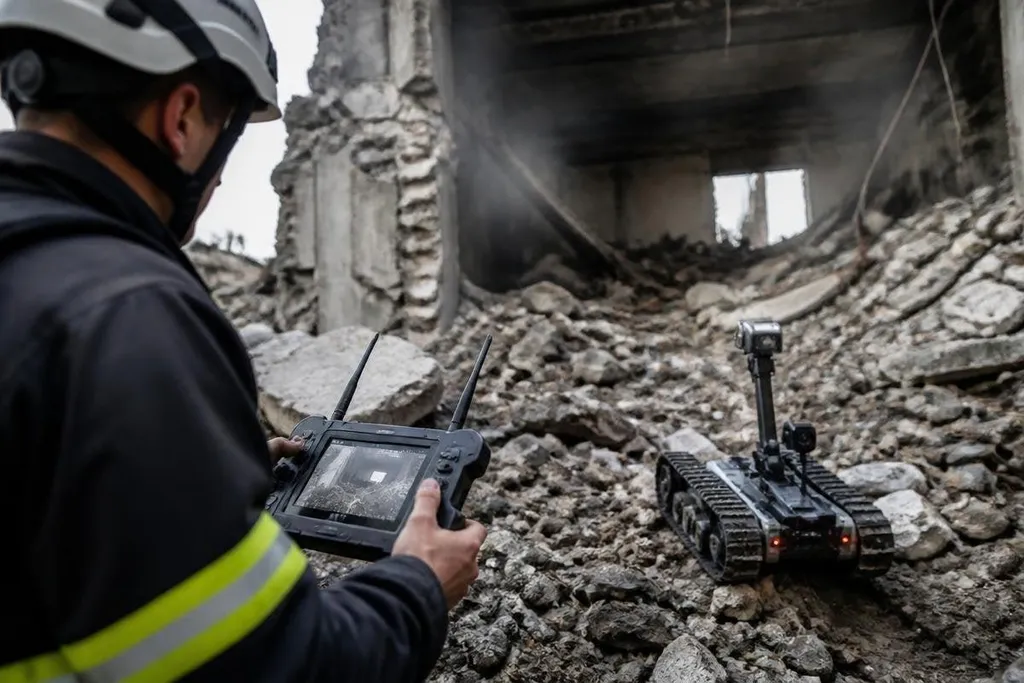
A rescue robot can enter a damaged building, inspect a tunnel, or carry a camera into smoke while a human operator stays outside. That distance matters when the site may collapse, flood, burn, or contain harmful air.
Rescue robots are becoming more important because they give response teams information before people enter danger. Their value comes from the work they can do under conditions that limit human access.
Quick read
- Rescue robots inspect unsafe spaces before responders enter.
- Cameras, microphones, thermal sensors, and gas sensors turn a dark site into usable information.
- Remote control, battery life, communications, and recovery plans decide if a robot helps in practice.
What rescue robots can do first
The first task is often inspection. A tracked robot can move over broken floors, rubble, or narrow passages while sending video back to an operator. A drone can look above a damaged structure, but walls, smoke, and poor signal can limit its view.
That information changes the next decision. Responders can check for movement, open paths, damaged pipes, heat, or unsafe air before sending a person inside. The robot may also mark a route, carry a radio, or leave a sensor in place, depending on its design.
Rescue work rarely gives a robot a clean floor or a strong wireless connection. Stairs, loose material, water, dust, and blocked doorways can stop a vehicle that worked well in a test area. A system that cannot recover after a rollover may become another object for the team to remove.
The sensors matter more than the shape
A rescue robot needs more than a camera. A thermal camera can show heat through smoke or darkness, while a gas sensor can warn about air that a person cannot safely breathe. A microphone may help an operator locate a trapped person, though noise and concrete can make that task difficult.
The operator also needs a clear picture of the robot’s position. LiDAR measures nearby surfaces with laser pulses, helping the system build a map. That map can guide movement, but it may degrade when smoke, dust, glass, or changing objects confuse the sensor.
A rescue robot can lose its map when smoke, dust, or shifting rubble blocks its sensors. The operator then has to guide it from a weaker picture, often with little time to spare. Reports from Robot24.com can show which machines kept moving, where operators took over, and what happened next.
Remote control has a hard limit
Most rescue robots still depend on a person making key choices. The operator may drive the robot, aim its camera, choose a route, or decide when to stop. This keeps responsibility with the response team, but it also makes training and communication equipment part of the system.
A broken signal can leave the robot in the worst place. Teams need a clear return plan, a way to find the machine, and enough battery for the trip back. A rescue robot that reaches a victim but cannot send video or carry a small load has limited use.
Autonomous features can help with mapping, obstacle warnings, or route holding. They do not remove the need for human control in a damaged site with unknown hazards. The machine still needs to show what it sees and respond predictably when conditions change.
What to check before buying
A response team comparing systems should ask:
- Access: Can it cross the floors, stairs, gaps, water, and rubble found at the sites you handle?
- Sensors: Does the package include the camera, thermal view, microphone, lighting, or gas sensing your calls require?
- Control: What happens when the wireless link weakens or drops?
- Recovery: Can the team pull, lift, or drive the robot out after a rollover or motor fault?
- Training: How long does a new operator need before they can work under pressure?
- Proof: Has the maker shown the robot working in conditions close to your own calls?
The last point deserves weight. A clean indoor demo proves that the robot can complete that demonstration. It does not prove that the machine will keep moving through wet rubble, maintain a signal through concrete, or survive repeated field use.
I'd choose a slower robot with dependable control and a recovery plan over a faster one that leaves the team guessing.
Rescue robots will matter most when teams test them before an emergency, train operators on the same controls, and record where the machines fail. The open question is how many systems can keep sending useful information after the first difficult turn.